Table Of Content
The House on Mango Street is a bildungsroman (coming-of-age story) of a young Chicana (Mexican-American) girl named Esperanza Cordero. The book is told in small vignettes which act as both chapters of a novel and independent short stories or prose poems. The story encompasses a year in Esperanza’s life, as she moves to a house on Mango Street in a barrio (Latino neighborhood) of Chicago, Illinois. The house on Mango Street is an improvement over Esperanza’s previous residences, but it is still not the house she or her family dreams of, and throughout the book Esperanza feels that she doesn’t belong there. Many of the young people are unruly and unsupervised, like the many childrenof Rose Vargas, while others, like Alicia, have to work hard at domestic choresand study at the same time.
Sandra Cisneros
Cristina Henríquez speaks to honors students, emphasizes importance of stories - The Crimson White
Cristina Henríquez speaks to honors students, emphasizes importance of stories.
Posted: Wed, 16 Oct 2019 07:00:00 GMT [source]
TO CANCEL YOUR SUBSCRIPTION AND AVOID BEING CHARGED, YOU MUST CANCEL BEFORE THE END OF THE FREE TRIAL PERIOD. You may cancel your subscription on your Subscription and Billing page or contact Customer Support at Your subscription will continue automatically once the free trial period is over. Our summaries and analyses are written by experts, and your questions are answered by real teachers. Esperanza wants nothing more than to have a house of her own but knows thatMango Street will always be a part of her and that she will come back for thosewho cannot leave.
Identity
Esperanza witnesses Alicia’s struggles and becomes aware that when the mother of a family passes away, all caregiving falls to the eldest daughter. Sally seems to represent the vicious cycle of domestic violence and repression felt by women on Mango street. She is utterly desperate to find a man to marry her, to escape the beatings and maltreatment she gets from her father at home.
Full Book Analysis
This ‘vicious cycle’ is seen when Esperanza goes and tells Sally's mother that her daughter is in a garden with three boys and the mother completely disregards this, her mother doesn't seem surprised or worried. Her mother cares for her cuts and bruises allowing for the violence to perpetuate,[21] both mother and daughter give excuses to the father. The bare fact that Sally marries at such a young age to a man that ends up treating her just like her father, shows how this cycle is so ingrained in the way of life of many women, and passed from generation to generation. The author pities this character, not blaming her for what happened to her, Sally was very young and immature to fully understand her surroundings, to find a way out. As the new girl on the block, Esperanza observes many of life's most joyous and harsh realities while meeting her Mango Street neighbors. Her first friend, Cathy, is a short-lived friendship because Cathy's father soon moves the family away because the neighborhood is getting bad, or in other words becoming more inhabited by lower-class Latinos like Esperanza's family.
An Introduction To Mexican Literature In 10 Works - The Culture Trip
An Introduction To Mexican Literature In 10 Works.
Posted: Tue, 04 Oct 2016 07:00:00 GMT [source]
The character is impressed upon by these forces and they guide her growth as a person. As she grows older, Esperanza has troubling glimpses of the adult world.When they are playing with the shoes, a vagrant approaches Rachel and asks herfor a kiss. Later, when Esperanza has her first job, an older man makes thesame request of her, claiming that it is his birthday. When she is about tokiss his cheek, he twists her face around and kisses her hard on the mouth.Esperanza also sees the pain and drudgery in her parents’ lives. When hergrandfather dies, her father breaks down in tears, and she thinks for the firsttime about what it would be like to lose him.
She has her fortune told by Elenita,the witch woman, but is disappointed by the vague prediction that she will have“a home in the heart,” when what she wants is a physical home away from MangoStreet. The House on Mango Street is a coming-of-age novel by SandraCisneros that follows the life of Esperanza Cordero, a young Latina girl, asshe navigates her life in a low-income Hispanic neighborhood in Chicago. The House on Mango Street is a collection of vignettes by Sandra Cisneros that explores Esperanza’s perspectives on the residents of Mango Street, a predominately Latino neighborhood. Esperanza is embarrassed by her family’s house, but she eventually embraces the neighborhood as part of her identity.

Chicano literature and culture
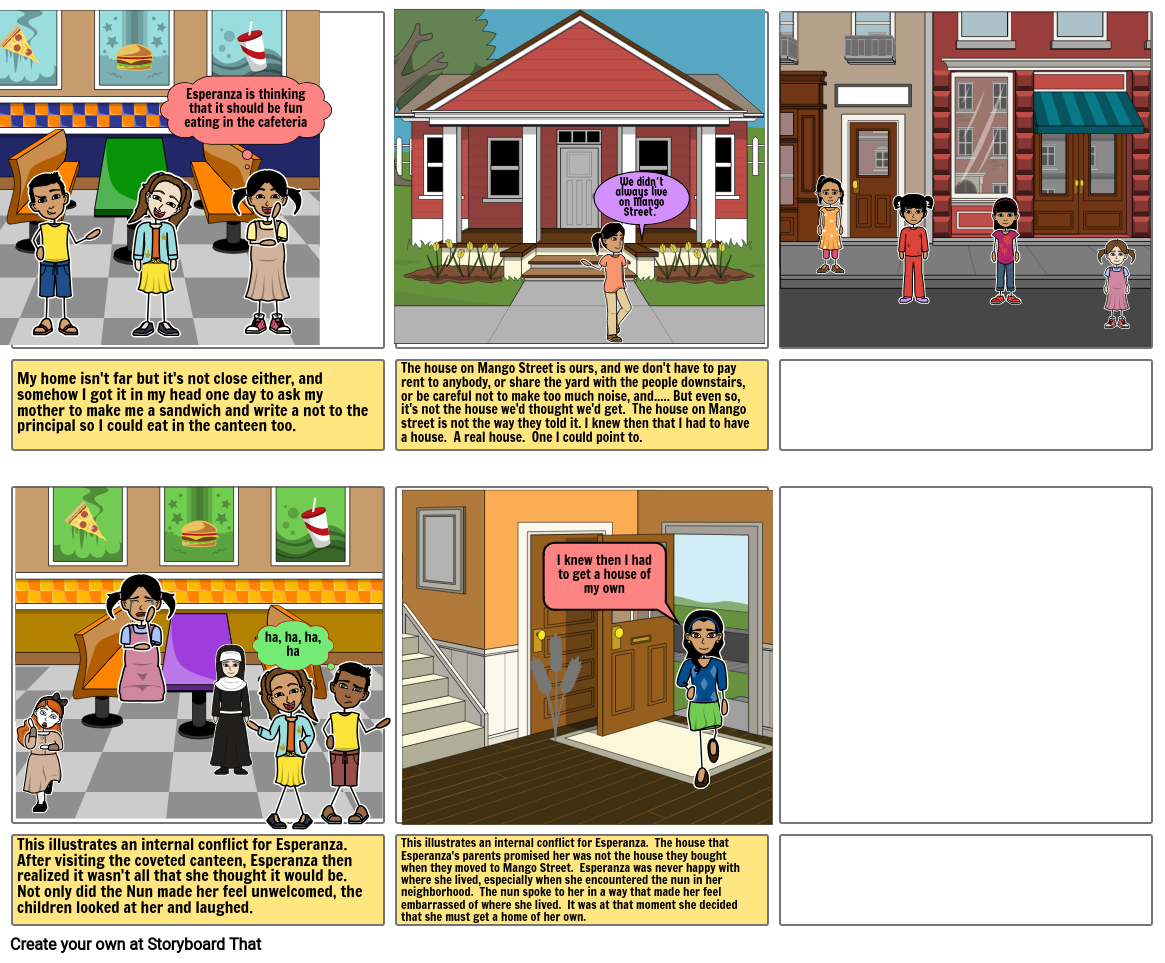
The novel begins when the Cordero family move into a new house, the first they have ever owned, on Mango Street in the Latino section of Chicago. It is not at all the dream-house her parents had always talked about, nor is it the house high on a hill that Esperanza vows to one day own herself. These experiences of male oppression, Esperanza’s growing creativity and desire to write, and her dream of a house of her own all cause Esperanza to want to escape Mango Street. At a neighbor’s funeral, three old sisters seem to read Esperanza’s mind and predict that she will leave Mango Street someday, but that she must not forget where she came from or the women still stuck there. By the end of the book, Esperanza is still in the same house, but she has matured and is confident that she is too strong to be trapped there forever. Her writing and story-telling lets her escape Mango Street emotionally, but it will also let her escape physically later through education and financial independence.
Trending Study Guides
The older kids on Mango Street open Esperanza's eyes to the hardships faced by young people in rough neighborhoods. Louie's cousin's car-theft, the hit-and-run death of a boy Marin meets at the dance, and Marin's own desperate attempts to find a husband to take her away show Esperanza the limited possibilities she herself faces. Alicia, on the other hand, exemplifies self-betterment and strength in the face of stereotypes to Esperanza. Alicia, despite her father's macho views, attends a university and studies all night so she can one day be more than her father's housekeeper. Sandra Cisneros’s The House on Mango Street is an internationally acclaimed novel, first published in 1984.
The House on Mango Street (SparkNotes Literature Guide)
Two other young sisters, however, adopt Esperanza into their circle when she chips in money to help them buy a bicycle. Lucy and Rachel help Esperanza ponder the wonders of growing up by inventing rhymes about hips and parading around Mango Street in high-heeled shoes. Along with chronicling Esperanza’s growth, the book’s vignettes also move through brief descriptions of her neighbors. While some of these portraits involve eccentric or memorable men (Meme Ortiz, Geraldo, or Earl), most of them involve women who are trapped in some way.
Esperanza begins the novel with detailed descriptions of the minute behaviors and characteristics of her family members and unusual neighbors, providing a picture of the neighborhood and examples of the many influential people surrounding her. She describes time spent with her younger sister, Nenny, and two older girls she befriends in the neighborhood; Alicia, a promising young college student with a dead mother, and Marin, who spends her days babysitting her younger cousins. Esperanza highlights significant or telling moments both in her own life and those in her community, mostly explaining the hardships they face, such as her neighbor being arrested for stealing a car or the death of her Aunt Lupe. She is excited when boys on the street or at a dance look at her; however, two instances of sexual violence destroy Esperanza's illusions of true love and her first kiss. So too, her promiscuous friend Sally's behavior also contributes to Esperanza's cynicism and caution when dealing with the opposite sex.
And when she does leave, Esperanza vows to return for those who are not strong enough to escape on their own. While Rosa is trapped in this imposed maternal identity, Alicia, another woman in Esperanza’s neighborhood, is oppressed by her role as caregiver. However, her father tries to return her to the patriarchal fold, explaining that a woman should tend the house and prepare food.
Nevertheless, Esperanza still dreams of sitting outside at night with her boyfriend, but she has set her standards higher than most of the women around her. She refuses to seek out a man to "escape," because she has seen too many neighbors unhappy in marriage. Ruthie, for example, has run away from her husband and has lost her senses; young Rafaela is so beautiful that her husband locks her indoors when he leaves.


No comments:
Post a Comment